

Compare Rust, Go, and C++ in production. Analyze memory management models, tail latency, raw throughput, security trade-offs, and backend workload fit.

Rust vs Go vs C++: Memory Management, Latency, and Throughput Compared
Choosing between Rust, Go, and C++ rarely comes down to synthetic microbenchmarks. When you’re running things in production, the choice really boils down to three things: how well the system handles memory under heavy load, whether latency stays steady when traffic suddenly spikes, and how quickly your engineers can ship safe updates without burning themselves out.
While all three languages compile to native machine code and power critical global infrastructure, they make fundamentally different architectural compromises. C++ prioritizes direct hardware control and maximum flexibility, Rust enforces memory and thread safety at compile time without a runtime, and Go trades raw execution efficiency for a concurrent garbage collector and rapid developer velocity. Below is a practical engineering breakdown of how each language handles memory, latency, throughput, and operational safety in real-world production environments.
Core Architectural & Memory Management Models
Understanding how each language allocates, tracks, and frees memory explains almost every performance characteristic you will observe in production.
C++: Manual Control and Deterministic RAII
C++ gives engineers direct access to raw pointers, manual heap allocations, and custom allocators. Modern C++ relies on Resource Acquisition Is Initialization (RAII) and smart pointers (std::unique_ptr, std::shared_ptr) to tie resource lifetimes to object scope. When an object goes out of scope, its destructor runs immediately and deterministically. However, the compiler does not prevent dangling references, iterator invalidation, or data races across threads; avoiding undefined behavior depends on code reviews, static analyzers, and runtime sanitizers (ASan, TSan).
Rust: Compile-Time Ownership and Borrowing
Rust achieves deterministic deallocation without a garbage collector through its ownership and borrow checker system. Every value has a single owner, references are strictly validated for lifetimes at compile time, and mutable aliasing is forbidden in safe code. When a variable exits scope, Rust inserts the drop call automatically. Because safety invariants are verified before binary generation, Rust eliminates use-after-free bugs, null pointer dereferences, and data races without incurring runtime tracking overhead—unless you explicitly opt into unsafe blocks for low-level FFI or hardware registers.
Go: Escape Analysis and Concurrent Garbage Collection
Go manages memory automatically using a low-latency, concurrent, tri-color mark-and-sweep garbage collector (GC). At compile time, Go’s escape analysis determines whether a variable can stay on the goroutine’s stack or must escape to the shared heap. While stack allocations are cheap, heap-allocated objects must eventually be scanned and reclaimed by the GC. Developers can tune garbage collection frequency via GOGC and set soft memory limits via GOMEMLIMIT, yet heap-heavy workloads still trade CPU cycles and memory headroom for programming simplicity.
Side-by-Side Technical Comparison
| Dimension | Rust | Go | C++ |
| Licensing & Tooling Cost | Open-source (MIT / Apache 2.0); free official toolchain (rustup, cargo) | Open-source (BSD-style); free official toolchain (go) | Open ISO standard; free compilers (GCC, Clang) + optional commercial IDEs/analyzers |
| Memory Management | Ownership & borrow checker (compile-time, deterministic) | Concurrent mark-and-sweep Garbage Collector + escape analysis | Manual + RAII / smart pointers (deterministic, developer-enforced) |
| Tail Latency (p99 / p99.9) | Flat and predictable; zero GC pauses | Sub-millisecond to multi-millisecond GC jitter under heavy heap churn | Flat and predictable; zero GC pauses |
| Raw CPU Throughput | Near-metal; matches C++ on most compute workloads | Lower on CPU-bound tasks due to runtime checks and GC overhead | Near-metal; unmatched access to mature SIMD/compiler intrinsics |
| Concurrency Model | async/await (Tokio) + OS threads with compile-time race safety | M:N green threads (goroutines) + channels (runtime scheduled) | OS threads, std::jthread, coroutines (manual synchronization) |
| Compilation Speed | Slowest (heavy monomorphization and borrow checking) | Fastest (designed for rapid incremental builds) | Slow (header inclusion and heavy template instantiation) |
| Best Production Fit | Storage engines, proxies, embedded, WebAssembly, security-critical services | Cloud-native microservices, control planes, API gateways, CLI tools | Game engines, HFT kernels, graphics pipelines, legacy systems |
Note on Licensing & Tooling Pricing: All three languages, their standard libraries, and their primary compilers (rustc, gc, GCC, Clang) are completely free and open-source. However, enterprise teams often pair them with commercial IDEs (such as JetBrains RustRover, GoLand, or CLion), static analysis suites, or CI/CD runners that follow per-seat subscription or usage-based pricing models. Visit each vendor’s official website and pricing page directly to verify current licensing tiers, regional taxes, and enterprise quotes.
Is Rust Faster Than C++?
In raw CPU-bound execution, Rust and C++ operate in the same performance tier—typically within a few percentage points of each other—because both target LLVM (or GCC) backends and avoid runtime garbage collection. Neither language is universally faster across every workload:
- Where C++ holds an edge: C++ allows unrestricted pointer aliasing, decades-old compiler-specific intrinsics, and cyclic data structures (like doubly linked lists or complex graphs) without reference counting (Rc/Arc) or arena allocators. In tight numerical loops or legacy hardware targets with proprietary C++ compilers, C++ can edge out Rust by small margins.
- Where Rust holds an edge: Rust’s strict aliasing rules (&mut T guarantees exclusive access) give LLVM stronger optimization guarantees, enabling auto-vectorization and register caching that C++ compilers cannot safely assume without manual __restrict__ annotations. Furthermore, Rust’s standard library uses modern algorithms (such as SwissTable for HashMap) out of the box.
For most production services, algorithmic choices, cache locality, and memory allocator selection (jemalloc or mimalloc vs. system malloc) impact speed far more than the language choice between Rust and C++.
Go vs Rust for Backend: Latency and Throughput in Production
When evaluating Go vs Rust for backend systems, the key distinction is not average response time—it is tail latency and memory footprint at scale.
- Network I/O and Microservices: For standard REST or gRPC services dominated by database queries and external API calls, Go’s net/http and goroutine scheduler saturate network interfaces effortlessly. Because goroutines start with a tiny stack (a few kilobytes) and grow dynamically, handling tens of thousands of concurrent connections is straightforward.
- Tail Latency Under Heap Pressure: Go’s garbage collector is heavily optimized, often keeping stop-the-world pauses well under a millisecond. However, when a service holds millions of live pointers in memory—such as an in-memory cache, telemetry aggregator, or streaming fan-out proxy—the GC must traverse that object graph. Under bursty traffic, this causes CPU spikes and p99.9 latency jitter. Rust avoids this entirely: memory drops predictably per request, keeping RSS memory usage 30% to 50% lower and p99.9 latency flat.
Below is how concurrent request fan-out looks idiomatic in both languages. In Go, concurrency is built into the runtime:
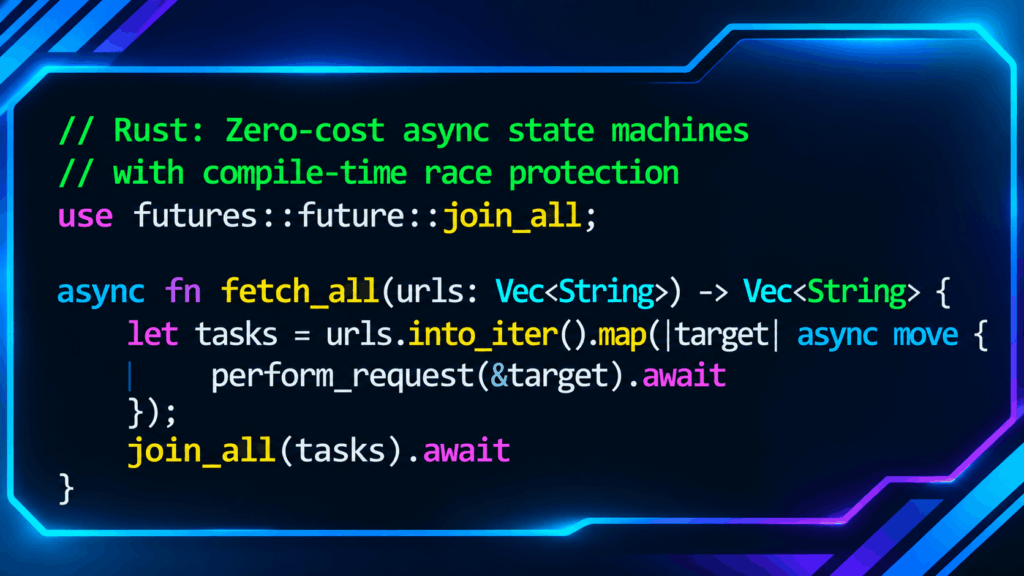
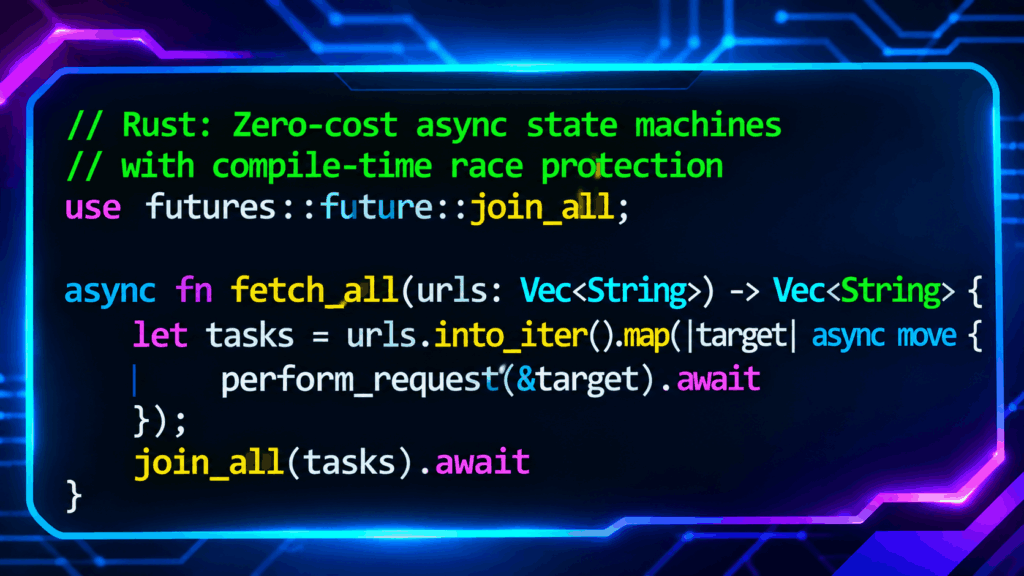
In Rust, async tasks compile into zero-allocation state machines driven by an explicit executor like Tokio, with compiler-checked thread safety (Send):
Operational, Security, and Compliance Considerations
Choosing a systems language carries long-term operational and security consequences beyond raw benchmark numbers:
- Memory-Safety Vulnerabilities: Industry vulnerability studies consistently attribute roughly 60% to 70% of high-severity security flaws in large C and C++ codebases to memory corruption (buffer overflows, out-of-bounds reads, and use-after-free errors). Rust eliminates these bug classes in safe code at compile time, reducing attack surfaces for internet-facing proxies, parsers, and cryptographic services—a major factor for teams operating under strict data-protection frameworks like GDPR or SOC 2.
- Dependency Supply Chain Risks: Rust’s cargo and Go’s module proxy make pulling third-party dependencies effortless, which increases supply-chain exposure. Production teams should pin dependency hashes (Cargo.lock, go.sum), run automated vulnerability audits (cargo audit, govulncheck), and generate Software Bills of Materials (SBOMs) in CI.
- Debugging and Observability: Go ships with built-in profiling (pprof), execution tracers, and a runtime race detector (go test -race) that make diagnosing production bottlenecks fast. Rust and C++ rely on OS-level profilers (perf, eBPF), flamegraphs, and DWARF debug symbols, which require deliberate container configuration in stripped production images.
- Hiring and Onboarding Velocity: New engineers typically ship production Go code within days. Rust and modern C++ require weeks or months of ramp-up before developers write idiomatic, deadlock-free code without fighting the compiler or subtle lifetime bugs.
Frequently Asked Questions
How does Rust vs C perform in low-level systems workloads?
Rust and C deliver virtually identical execution speed because both compile directly to native machine code without garbage collection or runtime overhead. C offers simpler binary layouts and universal platform support, whereas Rust matches C’s throughput while adding compile-time bounds checking and ownership verification to prevent buffer overflows and dangling pointers.

When should you choose Rust vs C for embedded development?
Choose Rust (no_std) for modern 32-bit microcontrollers (such as ARM Cortex-M and RISC-V) when memory safety, strong type-safe hardware abstraction layers (HALs), and modern package management matter. Stick with C when targeting legacy 8-bit or 16-bit architectures lacking LLVM backend support, or when integrating directly with vendor SDKs written exclusively in C.
Is Rust faster than Go across all backend workloads?
Rust is substantially faster than Go on CPU-bound workloads—such as compression, cryptography, image processing, and query execution—often outperforming Go by 2x or more due to zero garbage collection overhead and predictable cache locality. On I/O-bound web APIs waiting on databases or external networks, the speed gap narrows considerably, and Go’s faster build and iteration cycles often outweigh Rust’s runtime efficiency.
How does Rust vs Zig compare for modern systems programming?
Both Rust and Zig target bare-metal performance without garbage collection, delivering nearly identical runtime speeds. Rust enforces memory safety through its borrow checker and offers a massive ecosystem of over 150,000 libraries (crates.io). Zig omits the borrow checker in favor of a smaller language specification, manual allocator passing, unified compile-time metaprogramming, and seamless drop-in C interoperability.
How does Rust vs C# compare for high-throughput enterprise backends?
Modern .NET (C#) uses a highly tuned generational garbage collector, JIT/NativeAOT compilation, and Span<T> memory slices to achieve impressive throughput for enterprise APIs. However, Rust still maintains lower baseline RAM consumption, zero GC stop-the-world pauses at the p99.9 percentile, and smaller container footprints, making Rust better suited for resource-constrained edge nodes and infrastructure proxies.
What do Go vs C performance benchmarks typically show?
In compute-intensive benchmarks, C consistently outperforms Go because C avoids runtime bounds checks, goroutine stack management, and garbage collection sweeps. However, in high-concurrency network benchmarks, Go’s built-in non-blocking I/O poller (netpoller) and lightweight goroutines allow developers to achieve high network throughput with far less boilerplate than manual epoll or io_uring event loops in C.
Sources & Reference Points
- The Rust Programming Language Official Documentation & Rustonomicon
- Go Language Specification & Official Go Garbage Collector Guide
- ISO/IEC 14882 C++ Standard & C++ Core Guidelines
- TechEmpower Web Framework Benchmarks Methodology
- OpenSSF & CISA Memory-Safe Languages Guidance
- Zig Language Reference Documentation
- Microsoft .NET Performance & Memory Management Documentation