
Compare Rust vs C++ performance, memory safety, concurrency, and developer trade-offs with code examples, benchmarking guidance, and practical use cases.
Rust vs C++ Performance: Can Rust Match C++ Speed Without Memory Bugs?
Systems engineers face a persistent trade-off when building high-throughput services, embedded firmware, media pipelines, or low-latency trading engines. You need bare-metal control over CPU caches, stack and heap allocation, and predictable tail latency. Yet, memory corruption bugs remain one of the costliest sources of crashes and security vulnerabilities in production. C++ has anchored performance-critical software for decades with mature compilers and deep library ecosystems. Rust enters the same space with compile-time ownership checks that prevent entire classes of memory errors before code runs.
This article compares Rust and C++ across memory management, concurrency, raw execution speed, tooling, hiring, and production deployment. You will see how both languages handle real workloads, inspect short code examples, learn how to benchmark them fairly on your own hardware, and review practical criteria for choosing between them.
Short Answer
Yes, Rust can match C++ speed on many CPU-bound and systems workloads while eliminating data races and most memory safety bugs at compile time. Both compile to native machine code without a garbage collector and rely on zero-cost abstractions when written idiomatically.
The answer changes when workload details, optimization tuning, or legacy constraints take over. A seasoned C++ engineer who hand-tunes custom allocators, SIMD intrinsics, and compiler flags can sometimes edge out or match Rust, while poorly structured Rust code can still copy data unnecessarily or stall on async tasks.
Memory Management and Safety
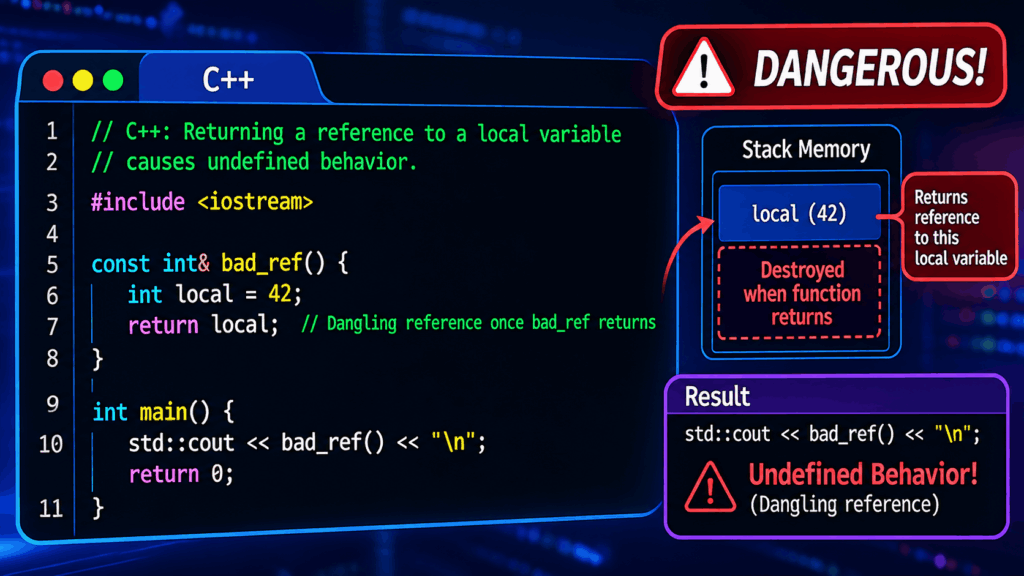
C++ gives you direct manual control over object lifetimes through constructors, destructors, raw pointers, and smart pointers such as std::unique_ptr and std::shared_ptr. The RAII (Resource Acquisition Is Initialization) pattern ties resource cleanup to scope exit, which works well when teams follow strict discipline. The catch is that the compiler rarely stops you from dangling references, use-after-free errors, double frees, or iterator invalidation when lifetimes cross complex call graphs or threads.
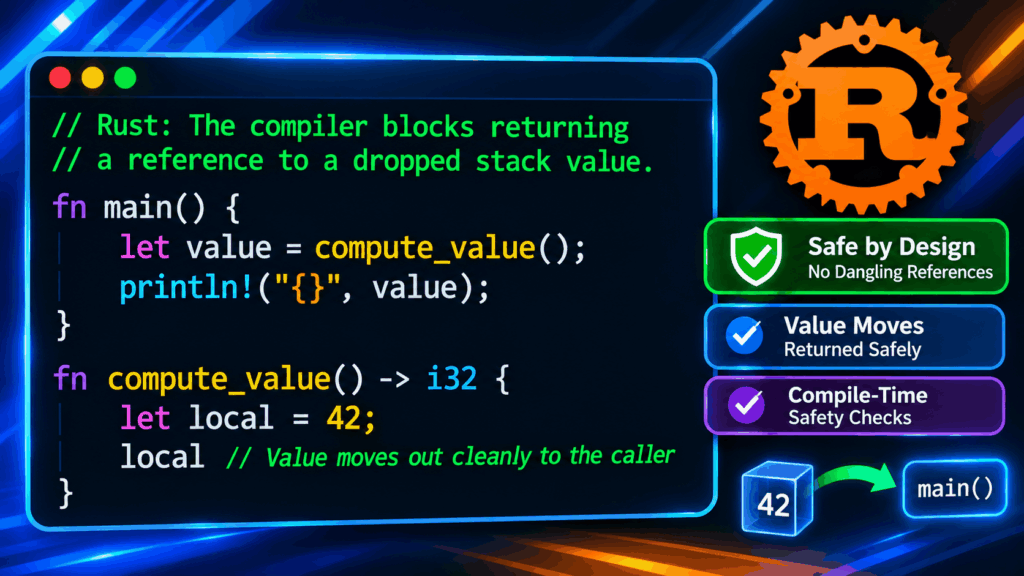
Rust enforces memory safety at compile time using ownership, borrowing rules, and lifetime checks. Every value has a single owner; references are either multiple shared readers (&T) or one exclusive mutable writer (&mut T), and the borrow checker rejects code that could leave a reference pointing to freed or mutated memory. Unsafe blocks (unsafe) still exist for FFI (Foreign Function Interface), hardware registers, or custom data structures, but they isolate risky operations rather than making them the default.
Concurrency Model
C++ provides standard threading primitives (std::thread, std::mutex, atomics, condition variables) alongside libraries and language features like coroutines. While fast, sharing mutable state across threads in C++ relies heavily on team conventions and runtime sanitizers such as ThreadSanitizer. Forgetting to lock a mutex or racing on a non-atomic flag can produce intermittent production bugs that are difficult to reproduce.
Rust treats thread safety as a type-level guarantee through the Send and Sync traits. Types implementing Send can transfer ownership across threads, and types implementing Sync can be safely referenced from multiple threads concurrently. If you try to pass a non-thread-safe type across threads without synchronization, the code fails to compile. For high-concurrency I/O, Rust also offers async/await powered by runtimes such as Tokio, whereas C++ often relies on OS threads, thread pools, asio, or custom event loops depending on your codebase.
Performance Characteristics
In practice, Rust vs C++ performance comes down to generated machine code, memory layout, and how well you avoid unnecessary allocations. Both languages lower high-level constructs into tight loops and inline functions under release optimizations, avoiding runtime garbage collection pauses. For compute-heavy loops, parsing, serialization, and network services, well-written Rust and well-written C++ frequently land in the same performance bracket.
Where differences appear is in edge cases and ergonomics. C++ has decades of specialized compiler flags, profile-guided optimization workflows, and mature vendor toolchains across niche chips. Rust makes certain optimizations easier to keep safe, such as passing exclusive mutable slices without alias ambiguity, which can help compilers optimize memory accesses. On the other hand, holding locks across .await points in Rust async code or cloning large buffers to satisfy the borrow checker can hurt latency if you are not paying attention.
Developer Velocity, Ecosystem, and Deployment
C++ has a massive, battle-tested ecosystem spanning game engines, graphics APIs, scientific computing, robotics, finance, and decades of internal libraries. However, dependency management in C++ has historically been fragmented across CMake, Meson, Bazel, vcpkg, and Conan, and build times on large template-heavy codebases can be slow.
Rust improves day-to-day workflow consistency with cargo handling builds, dependencies, tests, linting (clippy), and formatting (rustfmt) out of the box. Crates.io provides rich libraries for web services, CLI tools, networking, and systems tasks, though bindings to specialized C or C++ libraries still require wrapper crates or FFI glue. Both languages produce single self-contained native binaries or libraries suited to containers, bare-metal servers, and embedded targets without needing a language runtime installed on the host.
Hiring and Learning Curve
C++ has a broad pool of experienced engineers, especially in industries with long-lived codebases, though writing safe, modern C++ requires strong discipline and familiarity with many language standards and pitfalls. Rust has a steep initial learning curve because developers must model data ownership and lifetimes upfront rather than fixing memory bugs after compilation. Once teams pass that initial hump, many report fewer surprises during code review and refactoring because the compiler catches structural errors early.
Why Does Linus Torvalds Criticize C++ and Favor Rust in Kernel Work?
Linus Torvalds has long criticized C++ for its complexity, exception handling overhead, implicit copy constructors, and subtle surprises that make large low-level C codebases harder to audit and maintain. In kernel and driver development, predictable control flow and explicit behavior matter more than heavy language abstractions.
That perspective helps explain why Linux kernel maintainers introduced support for writing drivers in Rust alongside C. Rust does not replace existing C subsystems overnight, but it gives driver authors memory safety guarantees in new components while keeping direct hardware and kernel interactions explicit.
Is NASA Using Rust?
Public technical reports, open-source repositories, and engineering talks from space and aerospace teams show growing interest and experimentation with Rust for flight software, ground systems, and safety-critical tooling. Its compile-time memory safety and deterministic execution without garbage collection align well with reliability goals in aerospace environments.
At the same time, space missions depend on heavily qualified toolchains, rigorous verification standards, and proven heritage software. Teams evaluate Rust carefully against certification and hardware support requirements rather than adopting it blindly across every mission module.
Will Rust Overtake C++ in 2026 and Beyond?
Rust is unlikely to wipe out C++ anytime soon because trillions of lines of production C++, game engines, industrial controllers, and specialized libraries already exist and keep running reliably. Rewriting mature systems carries high cost and risk with limited business return when the existing C++ code works.
Instead, adoption in 2026 and beyond looks more like steady expansion into greenfield systems programming, security-sensitive network and infrastructure components, CLI utilities, and new modules next to C or C++. C++ remains entrenched where legacy ecosystems, specific hardware SDKs, or existing team expertise dominate.
When to Choose Each
Choose Rust when starting a new systems service, network daemon, security-sensitive parser, or concurrent backend where memory safety, thread safety, and modern tooling are top priorities. It is also a strong fit when multiple engineers contribute to complex state, and you want the compiler to enforce ownership boundaries continuously.
Choose C++ when maintaining or extending an established C++ codebase, integrating tightly with C++-only SDKs or game engines, or working on specialized hardware targets where C++ compilers and libraries have the strongest support. It is also practical when your team already has deep C++ fluency and strict static analysis and sanitizer pipelines in place.
| Scenario | Better Fit | Why |
| Greenfield concurrent network service | Rust | Compile-time data race prevention and cargo ecosystem speed up safe iteration |
| Existing C++ game engine or simulation | C++ | Direct compatibility with existing C++ APIs, middleware, and team skills |
| Security-sensitive data parser or edge proxy | Rust | Eliminates entire classes of buffer and lifetime bugs before deployment |
| Legacy enterprise or embedded C++ codebase | C++ | Avoids costly rewrites and preserves proven libraries and toolchain support |
| High-throughput CPU worker with mixed C/C++ libs | Either (lean C++ if heavy C++ FFI) | Both compile to native code; pick whichever minimizes FFI friction and bug risk |
How to Benchmark This Yourself
Never trust generic claims or synthetic microbenchmarks alone when deciding between Rust and C++. Measure a workload that mirrors your real data shapes, payload sizes, concurrency levels, and I/O behavior on target hardware.
Sample Workload: Line Counting and Word Frequency
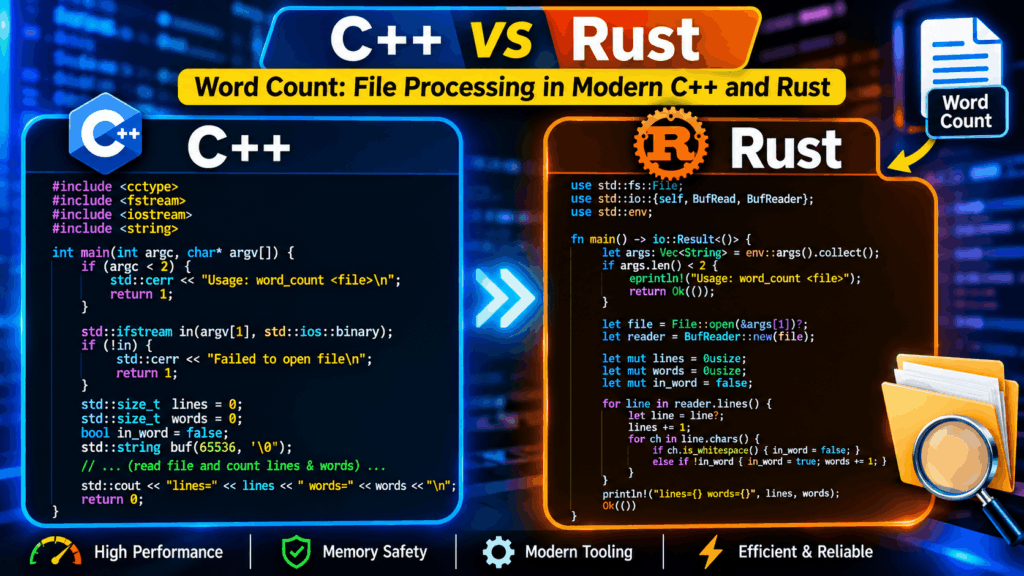
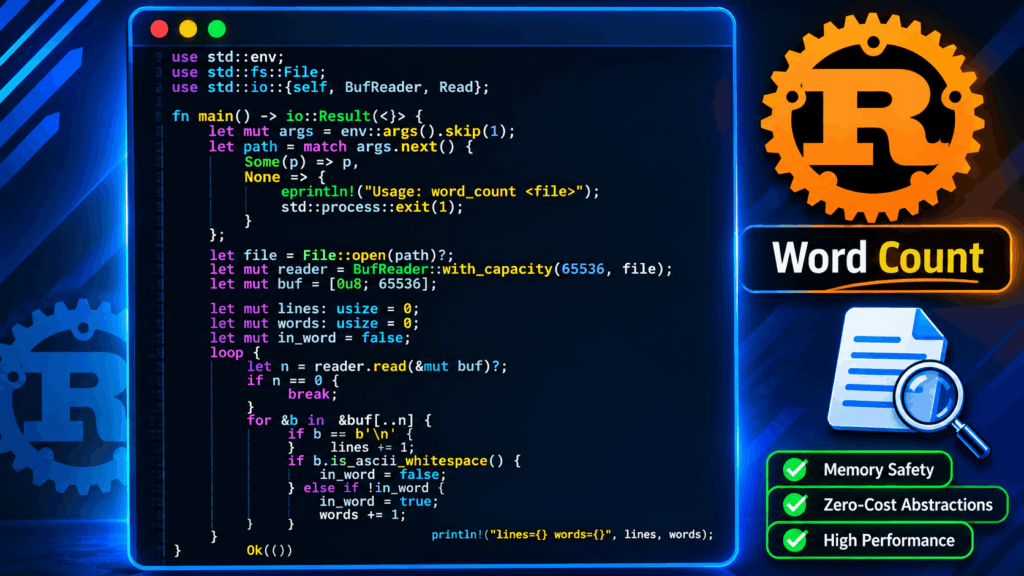
Below is a small, runnable pair of programs that read a text file and count lines and non-whitespace tokens. It is a simple I/O and string-scanning example, not a full production benchmark, and you should adjust it to match your real task.
Build and Run Commands
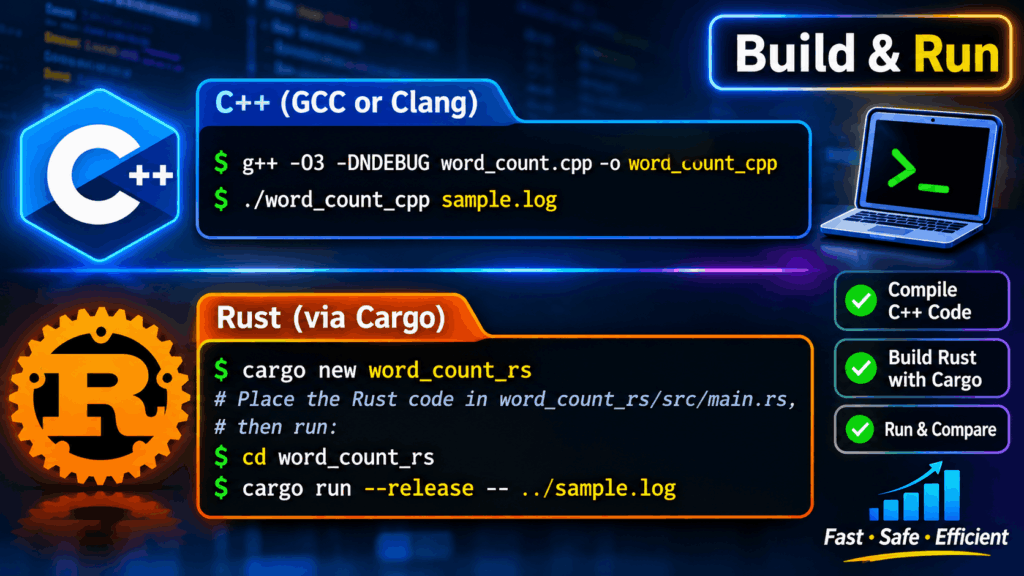
Compile both programs with optimizations enabled before measuring anything:
Metrics to Track and Common Mistakes
Track throughput (requests or megabytes processed per second), latency percentiles (p50, p95, and p99 rather than averages alone), peak resident memory (RSS), and cold-start time if running short-lived CLI tasks or serverless functions.
Avoid these common benchmarking mistakes:
- Benchmarking unoptimized builds: Running cargo run without --release or compiling C++ without -O2 or -O3 measures debug overhead, not production speed.
- Skipping warm-up and OS cache effects: Cold disk caches, CPU frequency scaling, and JIT or connection pools in surrounding services distort early runs.
- Testing toy inputs: Tiny files or artificial loops can fit in L1 cache or get optimized away entirely, hiding real memory bandwidth and allocation bottlenecks.
Operational and Security Considerations
Memory safety is a security advantage because out-of-bounds reads and writes, dangling pointers, and use-after-free flaws are frequent root causes of remote code execution and privilege escalation in native software. Rust reduces those risks in safe code, while C++ teams rely on strict coding standards, AddressSanitizer, UndefinedBehaviorSanitizer, and static analysis to catch defects early.
Neither language solves every operational concern on its own. Unsafe blocks in Rust can still introduce memory bugs if misused; logic flaws and injection vulnerabilities happen in any language, and modern build pipelines must manage third-party dependencies carefully. Pinning dependencies, auditing crates or C/C++ packages, enabling compiler hardening flags, and running reproducible builds help keep production systems reliable.
Final Verdict
Rust and C++ both deliver native speed without garbage collection, so raw performance alone rarely settles the debate. Choose Rust when starting new systems, concurrent network services, or security-sensitive components where compile-time memory and thread safety save debugging time down the road. Choose C++ when working inside an established C++ ecosystem, relying on C++-specific SDKs or hardware toolchains, or keeping an experienced C++ team productive on existing code.
Frequently Asked Questions
Is Rust really faster than C++?
In many real-world benchmarks, Rust and C++ perform within a narrow margin of each other because both compile to native code and avoid garbage collection. Neither is universally faster; outcomes depend on algorithm choice, memory allocation patterns, compiler flags, and how carefully the code is written.
What is the main difference in Rust vs C++ memory usage?
Both languages let you manage memory directly without a garbage collector, so peak memory usage depends largely on your data structures and buffer reuse. Rust encourages explicit ownership and borrowing that can prevent accidental extra copies, while C++ gives you fine-grained control over custom allocators and object layout.
How does Rust vs C++ syntax compare for everyday coding?
C++ syntax reflects decades of backward-compatible additions, templates, pointers, and operator rules that can feel dense or surprising. Rust syntax borrows ideas from C-family languages and ML-style functional languages, using explicit mutability (mut), pattern matching (match), and type annotations for lifetimes and traits.
How steep is the Rust vs C++ learning curve?
C++ is approachable for basic programs, yet mastering modern idioms, move semantics, templates, and memory pitfall avoidance takes years. Rust often feels harder during the first few weeks because the borrow checker enforces strict rules upfront, though many engineers find runtime debugging easier afterward.
How does Rust compare to C# for performance?
Rust runs natively without a garbage collector, giving predictable low-latency execution and tighter control over memory layout and startup time. C# runs on the .NET runtime with a generational garbage collector and JIT compilation, offering high throughput for many business and backend apps with less manual memory management.
How does Rust compare to Python for performance?
Rust is typically much faster than Python for CPU-bound tasks and tight loops because it compiles directly to native machine code rather than interpreting bytecode or calling slow Python object layers. Python shines for developer speed, scripting, glue code, and orchestrating libraries that already execute heavy work in native code.
Sources & Reference Points
- The Rust Programming Language (official documentation)
- Rust Reference (official language specification)
- Cargo Book (official build and package documentation)
- ISO/IEC 14882 (C++ standard specification)
- Linux Kernel Rust Documentation (official kernel documentation)